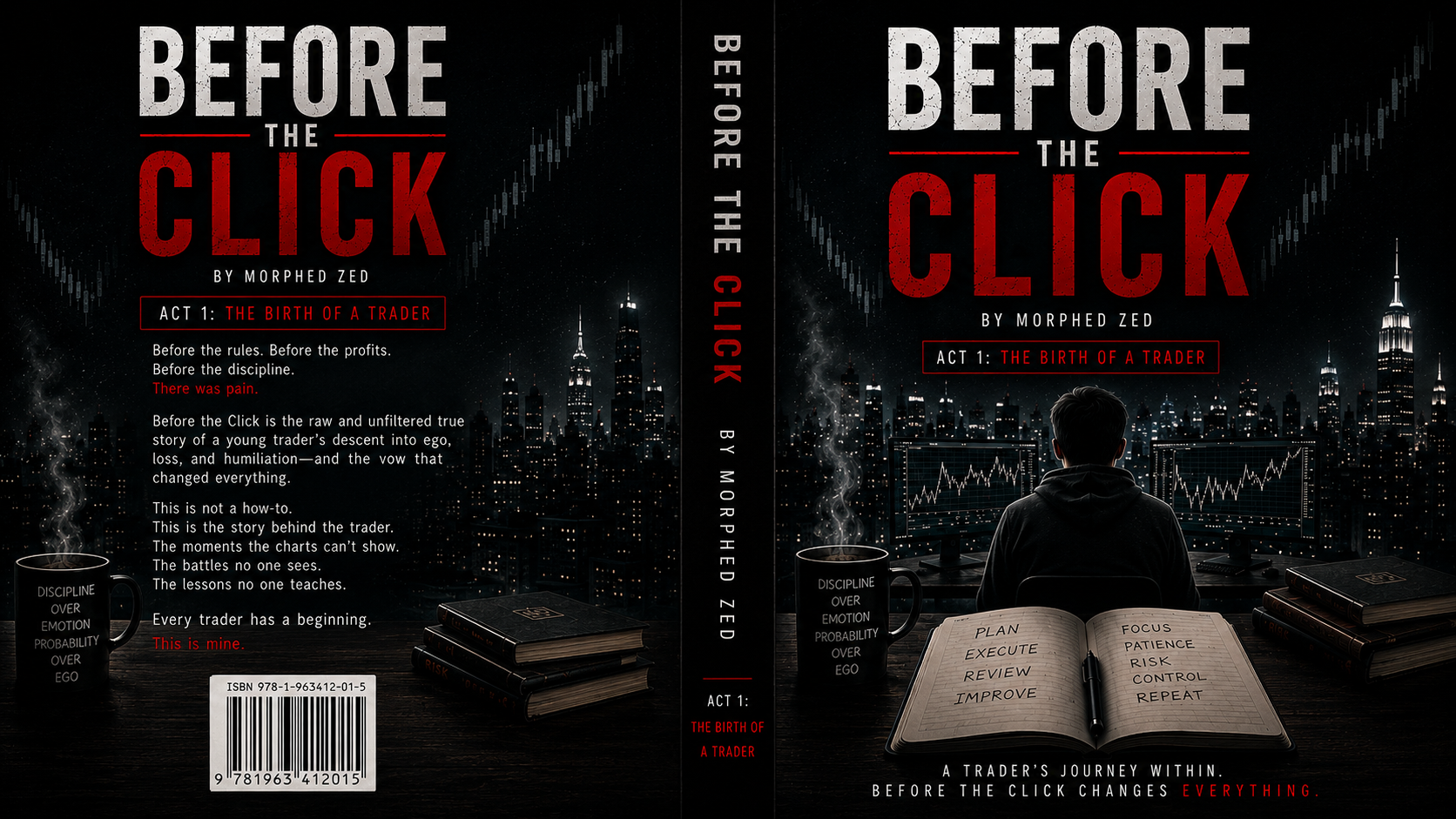
Before The Click (act I)
Chapter I: The Market Owes You Nothing
One of the hardest truths a trader will ever accept is this:
The market owes you absolutely nothing.
Not because you studied harder this week.
Not because you woke up early.
Not because yesterday ended in red and today should be different.
Trading has a brutal way of exposing the expectations we didn’t realize we carried.
Most of life teaches us that effort creates reward.
Study longer, score higher.
Practice harder, improve faster.
Work more, earn more.
Then trading arrives and tears that contract in half.
A perfect setup can lose.
A reckless trade can win.
That contradiction is where many traders begin losing control.
Freddie learned this the hard way.
It started like a normal morning.
Charts marked.
Bias established.
A warm cup of tea sitting beside the keyboard.
He waited.
A setup formed.
Everything aligned exactly how it was supposed to.
So he entered.
Then price turned.
Stopped out.
Small loss.
Nothing catastrophic.
But something shifted emotionally.
He leaned back in his chair and stared at the screen longer than necessary.
Not because of the money.
Because of the feeling.
The feeling that it shouldn’t have happened.
That’s the dangerous part.
Entitlement in trading rarely sounds arrogant.
It sounds frustrated.
"That trade should’ve worked."
"After all that patience?"
"I just need one clean move to get it back."
And just like that, the trader is no longer executing a plan.
He’s negotiating emotionally.
Five minutes later, Freddie saw another setup forming.
Not fully confirmed.
Not truly ready.
But emotionally, it felt close enough.
So he entered early.
Loss.
Now the breathing changes.
The shoulders tighten.
The clicking gets faster.
Analysis becomes thinner.
Emotion becomes louder.
Third trade.
Bigger size.
Because now it isn’t about the setup anymore.
Now it’s about proving something.
By lunchtime, what started as one disciplined loss had become a completely avoidable account wound.
And the painful truth?
The market didn’t do anything unfair.
It simply moved.
Freddie was the one who turned a probability event into a personal argument.
That’s what traders must understand.
The market is not your employer.
It is not your therapist.
It is not keeping score.
It does not know how hard you worked.
And the second you expect emotional compensation from it, discipline begins to erode.
Professional traders don’t see losses as insults.
They see them as outcomes.
That shift changes everything.
Because once you stop reacting emotionally to fairness, you start managing probabilities instead.
And probabilities don’t care about feelings.
They care about consistency.
Chapter I: The Market Owes You Nothing
One of the hardest truths a trader will ever accept is this:
The market owes you absolutely nothing.
Not because you studied harder this week.
Not because you woke up early.
Not because yesterday ended in red and today should be different.
Trading has a brutal way of exposing the expectations we didn’t realize we carried.
Most of life teaches us that effort creates reward.
Study longer, score higher.
Practice harder, improve faster.
Work more, earn more.
Then trading arrives and tears that contract in half.
A perfect setup can lose.
A reckless trade can win.
That contradiction is where many traders begin losing control.
Freddie learned this the hard way.
It started like a normal morning.
Charts marked.
Bias established.
A warm cup of tea sitting beside the keyboard.
He waited.
A setup formed.
Everything aligned exactly how it was supposed to.
So he entered.
Then price turned.
Stopped out.
Small loss.
Nothing catastrophic.
But something shifted emotionally.
He leaned back in his chair and stared at the screen longer than necessary.
Not because of the money.
Because of the feeling.
The feeling that it shouldn’t have happened.
That’s the dangerous part.
Entitlement in trading rarely sounds arrogant.
It sounds frustrated.
"That trade should’ve worked."
"After all that patience?"
"I just need one clean move to get it back."
And just like that, the trader is no longer executing a plan.
He’s negotiating emotionally.
Five minutes later, Freddie saw another setup forming.
Not fully confirmed.
Not truly ready.
But emotionally, it felt close enough.
So he entered early.
Loss.
Now the breathing changes.
The shoulders tighten.
The clicking gets faster.
Analysis becomes thinner.
Emotion becomes louder.
Third trade.
Bigger size.
Because now it isn’t about the setup anymore.
Now it’s about proving something.
By lunchtime, what started as one disciplined loss had become a completely avoidable account wound.
And the painful truth?
The market didn’t do anything unfair.
It simply moved.
Freddie was the one who turned a probability event into a personal argument.
That’s what traders must understand.
The market is not your employer.
It is not your therapist.
It is not keeping score.
It does not know how hard you worked.
And the second you expect emotional compensation from it, discipline begins to erode.
Professional traders don’t see losses as insults.
They see them as outcomes.
That shift changes everything.
Because once you stop reacting emotionally to fairness, you start managing probabilities instead.
And probabilities don’t care about feelings.
They care about consistency.
Chapter ii: Your Biggest Enemy Wears Your Face
Most traders enter this industry believing the challenge will be learning the charts.
Price action.
Market structure.
Liquidity.
Risk management.
Entries.
Exits.
And yes, those things matter.
But eventually, if you stay in this long enough, you discover something uncomfortable.
The chart was never the hardest part.
You were.
Freddie didn’t realize that at first.
Like most traders, he thought the solution was always outside of himself.
A better strategy.
A cleaner setup.
Different confirmations.
Maybe a new mentor.
Maybe a different session.
Maybe the issue was volatility.
Maybe smart money was just especially cruel that week.
There’s something oddly comforting about blaming the market.
Because if the problem lives out there somewhere, then you don’t have to examine what’s happening in here.
And that’s exactly where most traders stay stuck.
Freddie had rules.
Clear ones.
Wait for confirmation.
Respect risk.
No emotional entries.
Maximum trades per session.
On paper, he looked disciplined.
The kind of trader who should have been improving consistently.
And sometimes he was.
Monday went well.
Tuesday too.
Clean execution.
Controlled emotions.
Measured patience.
Then something would happen.
A strong win.
Nothing outrageous.
Just enough to create confidence.
Then confidence would begin changing shape.
That’s the dangerous thing about ego in trading.
It rarely announces itself.
It whispers.
"You’re seeing the market well this week."
"You can bend the rules a little."
"You probably don’t need full confirmation this time."
And slowly, discipline becomes optional.
Freddie would take a trade slightly earlier than planned.
Then justify it.
The next one might be slightly larger.
Still explainable.
Still defensible.
Until eventually, the week would begin collapsing.
A bad trade.
Then another.
Then emotional sizing.
Then frustration.
And by Friday, he wasn’t trading the market anymore.
He was trying to repair emotional damage with financial decisions.
Every week looked slightly different.
But somehow ended the same.
That’s when Freddie finally sat down and reviewed everything honestly.
Not just the losses.
The behavior behind them.
And what he found was difficult to accept.
His setups weren’t the issue.
The market wasn’t the issue.
His strategy wasn’t broken.
His discipline was.
That realization hits differently.
Because losing to the market is one thing.
Losing to yourself feels personal.
But this is also where growth begins.
Because once the problem has a name, it can be addressed.
The truth is, trading exposes parts of your personality most environments let you hide.
Impatience.
Fear.
Ego.
Greed.
Insecurity.
The need to be right.
The inability to sit still.
The market doesn’t create those things.
It reveals them.
That’s why two traders can look at the exact same chart and make completely different decisions.
One sees opportunity.
The other sees urgency.
One follows process.
The other follows emotion.
Same chart.
Different psychology.
That’s why becoming a better trader is often less about finding new strategies and more about becoming someone your own system can trust.
Because if your rules only exist when you feel calm, they’re not rules.
They’re suggestions.
And suggestions don’t protect accounts.
Discipline does.
The painful irony is that most traders spend months searching for better setups when what they really need is better self-awareness.
Because your biggest enemy in trading rarely arrives through the chart.
He logs into your account wearing your name.
Chapter Iii: The Dopamine Trade
Every trader remembers their first real win.
Not the tiny green trade that barely paid for lunch.
Not the accidental winner taken with bad execution and worse reasoning.
The one that felt different.
The one that made something click.
For Freddie, it happened on an otherwise forgettable afternoon.
No dramatic news event.
No wild volatility.
Just price moving cleanly.
Methodically.
Respectfully.
The kind of movement that makes the market feel understandable.
Freddie had been watching patiently.
Waiting.
Actually waiting.
Not pretending to.
Not forcing entries because boredom started sounding like intuition.
Real patience.
The setup formed.
Confirmation came.
Risk was defined.
Entry taken.
And for once...
Price moved exactly how he expected.
No immediate drawdown.
No fake-out.
No emotional whiplash.
Just movement.
Clean.
Smooth.
Profitable.
Freddie watched the numbers climb, and something inside him changed.
Not because of the money.
Not entirely.
It was the validation.
The dangerous kind.
Because money disappears.
Validation lingers.
For the first time, the market didn’t feel random.
It felt readable.
Beatable.
As if hidden beneath the noise was a language only disciplined people could learn.
And Freddie believed he had just heard his first sentence.
That feeling is intoxicating.
Because winning in trading doesn’t just reward your account.
It rewards your identity.
It whispers:
"Maybe you’re actually good at this."
That thought can be more addictive than profit itself.
Freddie carried that win into the evening.
Then into the next morning.
Then into his self-image.
He replayed the trade mentally.
Every entry detail.
Every candle.
Every confirmation.
He wasn’t studying anymore.
He was reliving.
That’s how obsession begins.
Quietly.
A trader tells himself he’s learning.
Improving.
Building discipline.
But beneath that, something chemical starts happening.
Dopamine.
Anticipation.
The chase.
The possibility of recreating that feeling.
Because after your first meaningful win, you’re no longer just trying to understand the market.
You’re trying to feel that moment again.
And markets punish emotional repetition.
The next trade wasn’t as clean.
Neither was the one after that.
But Freddie didn’t care.
Because somewhere beneath the logic, he wasn’t trading setups anymore.
He was hunting emotion.
That distinction destroys accounts.
Because when profit becomes emotional medicine, discipline starts making compromises.
And compromise in trading rarely looks dangerous at first.
It looks hopeful.
"This one looks close enough."
"This setup feels similar."
"One more trade."
Freddie didn’t realize it yet.
But his first win had taught him something more dangerous than failure ever could.
It taught him that trading could make him feel alive.
And once something can do that...
Walking away becomes harder.
Chapter iv: Screen Time
Obsession doesn’t usually announce itself.
It doesn’t kick your door open and declare its arrival.
It simply starts taking up more room.
An extra hour here.
A late night there.
A quick chart check that somehow becomes three.
For Freddie, it started innocently.
Education.
That’s what he called it.
And technically, he wasn’t wrong.
He studied relentlessly.
Market structure.
Liquidity.
Session timing.
Price delivery.
Risk models.
Psychology.
Replays.
Recorded trades.
YouTube breakdowns.
Community discussions.
Journal notes.
The more he learned, the more he realized how much he didn’t know.
And strangely, that made him want to learn even more.
At first, it felt productive.
Noble, even.
Other people relaxed after work.
Freddie studied.
Other people watched shows.
Freddie marked charts.
Other people slept.
Freddie told himself one more hour.
Then another.
Then another.
The glow of the monitors became its own atmosphere.
Time behaved differently there.
Midnight felt like 9 PM.
2 AM felt temporary.
Tea went cold beside the keyboard.
Conversations became shorter.
Replies took longer.
People noticed.
"You’ve been on that thing all day."
"You still studying?"
"You good?"
And Freddie always had an answer.
"Just working on something."
Because explaining trading to people who don’t live it is strange.
From the outside, it can look ridiculous.
Staring at moving lines.
Talking about probabilities.
Studying invisible behavior.
But from the inside?
It feels like learning how to read weather patterns in chaos.
And once that curiosity hooks you, normal life can start feeling...
Slower.
Less interesting.
That’s the danger.
Not because studying is bad.
Because imbalance is quiet.
Freddie started measuring days differently.
Not by experiences.
By setups.
By missed entries.
By what price did while he wasn’t watching.
That changes a person.
Because when your attention becomes permanently tethered to possibility, presence starts disappearing.
Dinner with charts nearby.
Phone alerts during conversations.
Checking futures before bed.
Thinking about market structure while pretending to listen.
The market had stopped being something Freddie studied.
It had become something Freddie carried.
Everywhere.
And obsession can masquerade as ambition for a very long time.
Until one day, someone asks how you’re doing...
And you answer with your P&L.
That’s when the lines start blurring.
Because discipline builds traders.
But obsession consumes people.
Chapter v: The Illusion of Control
Hard work usually pays.
That belief gets wired into us early.
Study harder.
Prepare more.
Outwork the competition.
Control the outcome.
That logic works in many parts of life.
Trading is different.
Freddie hadn’t accepted that yet.
So when inconsistency appeared, his response seemed logical.
Work harder.
Study longer.
Analyze more.
Surely better preparation meant better results.
So he doubled down.
More chart reviews.
More strategy testing.
More indicators.
More confirmations.
More rules.
More filters.
At first, this felt responsible.
Disciplined.
Professional.
But beneath that effort was a dangerous assumption.
That enough preparation could eliminate uncertainty.
It can’t.
And traders who believe it often become prisoners of over-analysis.
Freddie began searching for certainty disguised as preparation.
He wanted the perfect setup.
The perfect confirmation chain.
The perfect narrative.
A trade so clean it couldn’t possibly fail.
That trade doesn’t exist.
But the belief in it is expensive.
Because if you think perfection is possible, every losing trade feels like a mistake.
Every loss becomes evidence that you missed something.
So you study harder.
Add another confirmation.
Refine another rule.
Complicate what used to be simple.
And eventually, decision-making becomes paralysis.
Because now every trade carries impossible expectations.
Freddie would hesitate.
Second-guess.
Miss clean entries.
Then chase late.
Then lose.
Then blame execution.
When really, the issue was expectation.
Control feels comforting.
It creates the illusion of safety.
But markets do not reward control.
They reward execution under uncertainty.
That difference matters.
Because a trader trying to control outcomes becomes emotionally rigid.
A trader accepting uncertainty becomes adaptable.
Freddie was still trying to dominate randomness.
Trying to outwork probability itself.
And probability doesn’t negotiate.
No amount of chart time can guarantee an outcome.
No amount of effort can make uncertainty disappear.
That truth frustrates ambitious people.
Because ambitious people believe effort should bend reality.
Trading teaches otherwise.
Sometimes the best setup loses.
Sometimes mediocre execution wins.
And neither outcome changes the underlying truth.
Your job is not to control the market.
Your job is to control yourself within it.
Freddie would understand that eventually.
But not yet.
For now, he was still trying to build certainty inside a system designed around uncertainty.
And that misunderstanding would cost him.
Chapter VI: Revenge in a Suit
Revenge trading rarely looks like revenge.
That’s what makes it dangerous.
Most people imagine revenge as obvious.
Anger.
Desk slamming.
Shouting at the screen.
Wild entries with no thought behind them.
But Freddie’s version looked cleaner than that.
More convincing.
More professional.
At least on the surface.
Because emotional trading doesn’t always arrive looking emotional.
Sometimes it arrives wearing logic.
A well-explained thesis.
A detailed market bias.
A confident tone.
A trader who sounds certain enough to believe himself.
That was Freddie’s danger.
He didn’t spiral loudly.
He spiraled quietly.
The first sign was silence.
When Freddie was trading well, he was communicative.
Measured.
Clear.
His thoughts flowed normally.
But when emotion entered the room, something changed.
The talking stopped.
The room got smaller.
The charts got louder.
And everything outside the market started disappearing.
Tunnel vision.
That’s the best way to describe it.
Not focus.
Tunnel vision.
Because focus is intentional.
Tunnel vision is emotional captivity.
There’s a difference.
Freddie would begin convincing himself he saw things that weren’t actually there.
A move that looked "obvious."
A rejection that wasn’t fully confirmed.
A level that “had” to react.
The dangerous part wasn’t the bad idea.
It was how believable the bad idea sounded in his own head.
That’s how self-deception works.
It doesn’t announce itself as irrationality.
It presents itself as insight.
"This is the same setup from earlier."
"Price is clearly respecting structure."
"I know where this is going."
And perhaps the most expensive sentence in trading:
"I’ll make it back here."
That sentence has destroyed more accounts than bad strategies ever will.
Because the moment recovery becomes the objective, execution gets replaced by emotion.
Freddie stopped checking his checklist.
Not because he consciously abandoned discipline.
Because discipline became inconvenient.
And emotion is excellent at making convenience sound intelligent.
Why wait for confirmation when the move feels obvious?
Why respect risk when conviction feels high?
Why reduce size when certainty feels stronger than usual?
That’s how traders rationalize destruction.
Not through chaos.
Through confidence.
Freddie would over-explain trades to himself.
Not because the setup was actually strong.
Because saying it out loud made it feel more legitimate.
The explanation became emotional camouflage.
A way to dress impulse in professional language.
And the terrifying thing is that from the outside, it could look disciplined.
Charts marked.
Bias explained.
Language polished.
But internally?
It was emotional gambling.
That’s what many traders never understand.
Gambling doesn’t always look reckless.
Sometimes it looks analytical.
Freddie thought his biggest danger would be fear.
Fear of pulling the trigger.
Fear of losing.
Fear of uncertainty.
But fear wasn’t his most expensive emotion.
Ego was.
Because fear makes traders hesitate.
Ego makes them override.
And overriding discipline is far more destructive than hesitation.
A fearful trader misses opportunities.
An egotistical trader creates disasters.
Freddie didn’t realize how often he was trading from wounded pride instead of actual probability.
Not yet.
He thought he was becoming more confident.
More decisive.
Sharper.
But confidence built on emotional instability isn’t confidence.
It’s volatility wearing a suit.
And volatility always collects its debt.
Chapter VII: The Day I Gave It Back
There are losses.
And then there are losses that permanently change how you hear silence.
Freddie was seventeen.
Still young enough for people to call him a kid.
Old enough to believe he had to become a man immediately.
By then, trading had already become more than curiosity.
It had become possibility.
And possibility is dangerous when you’re young enough to believe freedom might only be one breakthrough away.
A family friend named Mike had trusted Freddie with something fragile.
Money.
Not an extraordinary amount.
Fifteen hundred dollars.
But when trust is involved, numbers change weight.
Fifteen hundred dollars wasn’t just capital.
It was belief.
And Freddie took that seriously.
At first.
He traded carefully.
Measured.
Patiently.
The kind of patience that only exists when there’s still something to protect.
And somehow, it worked.
The account climbed.
Slowly at first.
Then faster.
A clean trade here.
Another there.
Momentum building.
Freddie watched that fifteen hundred become something bigger.
Something real.
Five thousand three hundred dollars.
At seventeen, that number doesn’t just look like money.
It looks like escape.
Proof.
Validation.
Air.
For the first time, Freddie felt like he had something undeniable.
Something he could point to.
Something no one could argue with.
Look.
It’s working.
So he made the mistake that confidence often makes for us.
He told Mike.
Not to brag.
Not entirely.
Part of him was proud.
Part of him wanted to prove this wasn’t just some fantasy.
Part of him wanted someone else to see what he saw.
And maybe that was the real danger.
Because once someone else witnesses your success…
ego gets involved.
The next day, Freddie sat in front of the market believing he was sharper than before.
Not reckless.
Not yet.
Just... looser.
SPY was moving.
Price delivering opportunities.
Or what looked like opportunities.
The first loss came quickly.
Five hundred dollars.
Painful.
But manageable.
A professional would reset.
Freddie didn’t.
The second loss came.
Another five hundred.
Now emotion entered the room.
The breathing changed.
The internal dialogue changed.
The objective changed.
This was no longer about execution.
This was about recovery.
Then a thousand disappeared.
At that point, logic was no longer driving.
Pride was.
Because somewhere in Freddie’s mind, one thought had become unbearable:
I already told him.
That sentence changes people.
Especially young ones.
Especially people who already tie self-worth to outcomes.
So Freddie did what emotional traders do when pain starts sounding urgent.
He overleveraged.
Convinced himself one aggressive move would fix everything.
That the market owed him a reversal.
That confidence would somehow rewrite probability.
It didn’t.
Within an hour...
it was gone.
Not gradually.
Not mercifully.
Gone.
Freddie stared at his phone.
Still.
His heart felt strange.
Not heavy.
Light.
As if something inside him had become weightless in the worst possible way.
His stomach felt like it was floating somewhere above where it belonged.
His eyes stayed fixed on the screen.
Not blinking much.
Just disbelief.
Because the brain does strange things when reality arrives too fast.
He wasn’t even fully processing the money.
He was processing the fallout.
How do I explain this?
What is he going to think of me?
I did this.
I actually did this.
And then something happened that Freddie had never heard from himself before.
A sound.
Small.
Muffled.
A strained, broken little noise caught behind closed lips.
Not quite crying.
Not quite speaking.
Just pain trying to leave the body without permission.
That moment stayed with him.
Not because of the money.
Because that was the first time Freddie understood what self-destruction felt like in real time.
And the market was done with him.
But life wasn’t.
Because losing the money wasn’t the real consequence.
That came later.
When Mike showed up.
And brought everyone with him.
Chapter VIII: The Hustler’s Lie
After enough humiliation, ambition can start wearing strange faces.
From the outside, Freddie looked driven.
Hungry.
Focused.
Resilient.
The kind of person people admire in hindsight.
The kind of person others call “built different.”
But appearances can be misleading.
Because not all ambition comes from inspiration.
Some ambition comes from fear.
And fear is a far more exhausting fuel source.
After losing the money.
After the confrontation.
After hearing adults reduce his effort, his mistakes, and his dream into something stupid…
something hardened inside Freddie.
Not discipline.
Something sharper.
A vow.
No one would ever speak to him like that again.
Not unless they had something tangible to stand on.
At the time, that sounded like motivation.
It sounded powerful.
Productive, even.
But wounded ambition can be dangerous.
Because pain doesn’t always create wisdom.
Sometimes it creates obsession.
Freddie became convinced success would solve something much deeper than finances.
He told himself he wanted freedom.
Independence.
Control.
Those things were true.
But they weren’t the whole truth.
The whole truth was uglier.
Freddie didn’t just want success.
He wanted insulation.
He wanted armor.
He wanted enough money that criticism would sound ridiculous coming from the mouths of ordinary people.
Enough proof that no one could question him again.
Enough control that no one could ever offer him surrender disguised as help.
That kind of ambition burns hot.
And hot things don’t always illuminate.
Sometimes they destroy.
That’s the lie hustlers tell themselves.
That pain-fueled obsession is noble.
That endless grinding is discipline.
That emotional exhaustion is proof of commitment.
That sleep deprivation means dedication.
That suffering guarantees outcomes.
But pain is not the same thing as purpose.
And Freddie hadn’t learned that yet.
So he pushed harder.
Longer hours.
More research.
More screen time.
More internal pressure.
He told himself he was just more serious now.
That the weak version of him had died.
That humiliation had sharpened him.
But beneath that story…
there was fear.
Fear of going backward.
Fear of dependency.
Fear of being ordinary.
Fear of becoming someone whose life could be dictated by another person’s approval.
Fear can make incredibly hardworking people.
It can also make deeply unhealthy ones.
Freddie began tying his worth to progress.
A good week meant he was becoming someone.
A bad week meant he was failing again.
There was no emotional middle ground.
Only momentum or collapse.
That mindset feels powerful at first.
Until you realize it makes peace impossible.
Because if your self-worth depends on performance…
rest starts feeling irresponsible.
And when rest feels irresponsible, burnout becomes inevitable.
Freddie didn’t recognize any of this in real time.
To him, he was simply doing what ambitious people do.
Grinding.
Sacrificing.
Building.
That’s the dangerous thing about self-deception.
It rarely sounds dishonest.
It sounds inspiring.
People celebrate obsession when it looks productive.
No one asks enough questions while the person is still moving.
But motion doesn’t always mean progress.
Sometimes it’s just running from something.
Freddie wasn’t ready to ask himself what that something was.
So instead…
he kept moving.
Chapter IX: Buying Certainty
Desperate people don’t always buy solutions.
Sometimes they buy certainty.
Or at least the illusion of it.
Freddie was seventeen, working long hours at Domino’s for eleven dollars an hour, trying to convince himself he was building something bigger than the life everyone expected him to settle for.
And when you’re in that position…
certainty becomes incredibly seductive.
That’s exactly what the mentor sold.
Not education.
Not really.
Certainty.
The kind packaged in expensive cars.
Luxury interiors.
Designer confidence.
Clean screenshots.
Casual arrogance.
The kind of person who made wealth look effortless.
And to someone trying to escape powerlessness?
That image is magnetic.
Because it doesn’t just sell strategy.
It sells identity.
This could be you.
That sentence has emptied more wallets than bad trading ever has.
Freddie paid two hundred and twenty-five dollars a month.
At the time, that wasn’t “investing in himself.”
That was sacrifice.
Real sacrifice.
Long hours.
Off-the-clock work.
Money that actually mattered.
Money that could have gone elsewhere.
But when someone makes certainty look attainable, logic starts negotiating.
"If this gets me there faster, it’s worth it."
That’s how desperation talks.
The first few lessons felt exciting.
Validation.
A real mentor.
A real path.
Someone who supposedly knew what they were doing.
Freddie listened carefully.
Took notes.
Absorbed everything.
Price action.
Basic concepts.
Terminology.
The language of trading.
At first, it felt like progress.
Until something uncomfortable happened.
Freddie started looking things up himself.
Simple searches.
YouTube videos.
Free educational content.
Books.
Forums.
And slowly, an ugly realization formed.
Much of what he was paying for…
was already available for free.
That stings differently when every dollar costs actual labor.
Because losing money through bad trades hurts.
But realizing you willingly handed money over for recycled information?
That creates a different kind of anger.
Still, Freddie held on.
Because once you pay enough, pride gets involved.
People don’t like admitting they’ve been sold a dream.
So they rationalize.
"The real value must be coming later."
"I just need to trust the process."
That phrase should come with a warning label.
Trust the process.
Three words that can mean patience…
or manipulation.
Depends who’s saying them.
Then the mentor started fading.
Less engagement.
Less teaching.
Less presence.
The energy shifted.
Questions went unanswered.
The consistency disappeared.
People in the Discord started noticing.
Then came the whispers.
Then frustration.
Then silence.
And eventually…
absence.
Freddie had paid for guidance.
What he got was a lesson.
Not the one he expected.
Because this chapter was never really about one mentor.
It was about vulnerability.
About what happens when someone is hungry enough to confuse confidence with competence.
That’s a painful lesson in trading.
And in life.
But Freddie wasn’t done learning it.
Because when one false certainty collapses…
most traders don’t stop searching.
They just go looking for the next one.
A different guru.
A cleaner strategy.
A better indicator.
A sharper framework.
Anything that promises relief from uncertainty.
That’s the trap.
Because uncertainty isn’t a flaw in trading.
It is trading.
And anyone selling certainty is selling fiction.
Freddie didn’t know that yet.
At that point, he still believed the right system could save him.
That the missing piece lived somewhere outside himself.
A better teacher.
A better strategy.
A better explanation.
He would spend years discovering how wrong that assumption was.
Because the most expensive things traders buy…
are often invisible.
Chapter X: Rock Bottom Has Wi-Fi
Humiliation has a strange aftertaste.
It doesn’t always arrive as sadness.
Sometimes it arrives as heat.
As tight jaws.
As watery eyes that refuse to blink.
As rage pretending to be composure.
Mike didn’t call Freddie privately.
He didn’t sit him down one-on-one.
He didn’t offer correction with dignity.
He went to Freddie’s parents.
And suddenly, something that had started between two people became public.
That changed everything.
Because losing money is painful.
Being exposed is something else entirely.
Freddie had no real choice in the matter.
The meeting happened.
Mike.
His mother.
His father.
And Freddie.
Seventeen years old.
Sitting in a room where every adult had already decided what he was.
That kind of environment doesn’t invite understanding.
It invites judgment.
Mike was furious.
And understandably so.
Money had been lost.
Trust had been broken.
But anger has a way of turning explanation into execution.
So Freddie didn’t feel like someone being corrected.
He felt like someone being sentenced.
The words came quickly.
Sharp.
Heavy.
Accusatory.
Trading was called gambling.
Irresponsible.
Stupid.
A waste.
A fantasy.
The kind of dream unserious people chase when they don’t want real work.
And then came the offer.
If Freddie wanted stability…
he could come home.
But it wouldn’t be freedom.
No phone.
No independence.
Rules.
Chores.
Obedience.
Compliance.
Return to the structure he had already mentally escaped.
To some people, that might sound like support.
To Freddie, it sounded like captivity.
That distinction matters.
Because people only interpret safety as safety when they trust the environment offering it.
Freddie didn’t.
Not emotionally.
Not anymore.
His eyes watered.
Not because he felt broken.
Because he felt cornered.
Disrespected.
Reduced.
There’s a difference.
Sadness folds inward.
Anger stands upright.
And Freddie was angry.
Angry that Mike went to his parents instead of him.
Angry that nobody wanted explanation.
Angry that the mistake had somehow become evidence that his entire dream was fraudulent.
Angry that people who had never sat in front of a chart suddenly had absolute certainty about what trading was.
But beneath the anger was something worse.
Recognition.
Because somewhere underneath all the noise…
Freddie knew something painful.
They weren’t entirely wrong about one thing.
He had done this.
No market manipulation.
No conspiracy.
No hidden villain.
No impossible odds.
Him.
His decisions.
His ego.
His emotional spiral.
That realization is devastating because it removes the easiest coping mechanism.
Blame.
And when blame disappears, accountability arrives naked.
That moment changes people.
Some collapse under it.
Some walk away.
Some decide they were never built for this.
Freddie chose something else.
Something less healthy.
Something far more dangerous.
He made a promise.
Not out loud.
Not dramatically.
No speech.
No grand performance.
Just a quiet internal contract forged somewhere between humiliation and fury.
No one would ever talk to him like that again.
And if they did…
they’d at least be standing in a lower tax bracket.
At seventeen, that thought didn’t feel toxic.
It felt empowering.
Motivational.
Like fuel.
And maybe, for a while, it was.
But pain-driven ambition has a hidden cost.
Because when success becomes revenge…
peace becomes impossible.
Freddie didn’t know that yet.
All he knew was that something had changed.
The boy who wanted freedom had become someone willing to chase it with his teeth.
And somewhere in the silence after that meeting…
a more dangerous version of Freddie was born.
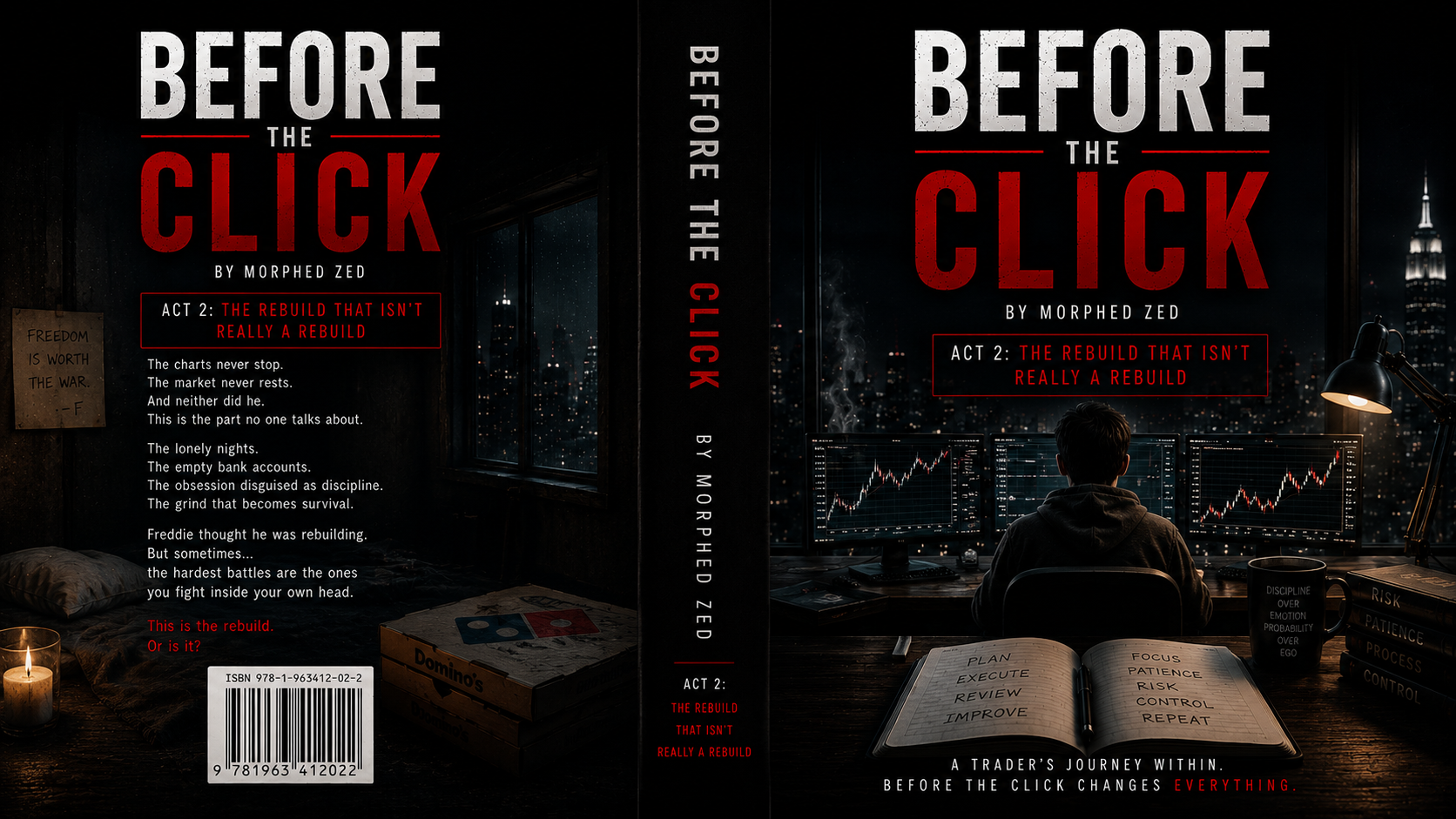
Before The Click (ACT II)
Chapter XI: The Hunger Looks Different Now
Humiliation changes people.
Not always in obvious ways.
Sometimes it doesn’t make them weaker.
Sometimes it makes them quieter.
Colder.
More difficult to reach.
Like a door inside them has learned how to lock from the inside.
Freddie didn’t touch the market for a while after what happened.
Not because he suddenly agreed with everyone.
Not because he believed trading was gambling.
Not because the dream died.
Because guilt has weight.
And guilt is heavy enough to make even obsession sit still.
For nearly two months, the charts kept moving without him.
Candles formed.
Setups came and went.
Money changed hands.
And Freddie watched none of it.
That kind of absence sounds healthy.
Like healing.
Like reflection.
But absence doesn’t always mean peace.
Sometimes it just means the war moved inward.
Because while Freddie wasn’t trading...
he was thinking.
About Mike.
About the meeting.
About the voices.
About the way grown adults can look at you when they’ve already decided what kind of person you are.
About that room.
About the fact that he had done exactly what they said he would do.
That part hurt the most.
Not because they understood trading.
They didn’t.
But because Freddie had given them evidence.
That kind of truth is difficult to outrun.
And yet...
another thought kept surfacing.
A quieter one.
A dangerous one.
I turned fifteen hundred into fifty-three hundred.
That thought didn’t sound defensive.
It sounded factual.
Because it was.
Yes, he gave it back.
Yes, he self-destructed.
Yes, ego poisoned the outcome.
But before all of that?
Something had worked.
That mattered.
Maybe more than it should have.
Freddie couldn’t stop replaying it.
Not the failure.
The proof.
Because humiliation has a strange effect on ambitious people.
It doesn’t just create doubt.
Sometimes it creates obsession.
The logic became simple.
Twisted.
But simple.
If I did it once...
I can do it again.
That sentence has rebuilt people.
And ruined them.
Freddie became colder after that.
Not dramatically.
Not in a way people immediately notice.
It was subtler.
He stopped explaining himself.
Stopped caring whether people understood his perspective.
Stopped needing emotional permission to pursue what made sense to him.
Or what felt like it made sense.
Pain will do that.
Especially when it comes packaged as public humiliation.
And while everyone around him likely thought the incident had scared him straight...
something else was happening.
Freddie was changing shape.
He became more spiteful.
Not outwardly.
He wasn’t walking around picking fights.
But internally?
Something hardened.
There’s a particular kind of resentment that forms when people reduce your biggest mistake to your entire identity.
Freddie carried that.
Quietly.
And quietly carried resentment can be incredibly productive.
For a while.
Because if pain is converted into ambition, people call it discipline.
But not all discipline is healthy.
Some of it is trauma with a schedule.
Freddie didn’t know that yet.
All he knew was he hated the idea of being ordinary.
Hated the thought of clocking in forever.
Hated the idea that life was supposed to be:
work
save
retire
rest
as if freedom was a reward handed out only after decades of obedience.
That worldview felt insane to him.
Like being asked to spend your entire life earning permission to finally live it.
Freddie rejected that entirely.
Violently.
Not because he was lazy.
Because he needed control.
Needed ownership.
Needed breathing room.
That distinction matters.
A lot of people misunderstand ambition.
They assume everyone chasing wealth wants luxury.
Cars.
Watches.
Status.
Some do.
Freddie wanted autonomy.
There’s a difference between wanting wealth...
and wanting no one to control your time.
The latter can become far more dangerous.
Because desperation doesn’t always look frantic.
Sometimes it looks focused.
And Freddie was becoming focused in the most dangerous way possible.
His brain hyper-focused when things mattered emotionally.
That was both a gift and a curse.
When locked in, he could disappear into ideas.
Into strategy.
Into systems.
Into patterns.
Into possibility.
But hyper-focus has a darker twin.
Dissociation.
And Freddie had both.
When reality became too heavy, his mind had ways of escaping.
That kind of wiring makes some people brilliant.
It also makes emotional self-deception terrifyingly easy.
Because obsession can feel productive.
Even when it’s actually avoidance.
The strangest part?
Despite everything...
Freddie wasn’t asking himself whether trading was possible anymore.
That question had already been answered.
It was.
He had seen enough proof.
The real question had changed.
Now it was:
Can I survive becoming the kind of person this pursuit requires?
He wouldn’t have phrased it that way back then.
Back then, his internal dialogue was much simpler.
Much younger.
Much more reckless.
Whenever fear showed up, he had one answer for it.
One phrase.
One challenge.
What’s the worst that could happen?
That question sounds fearless.
Until you realize it usually comes from people who’ve already survived enough to stop respecting danger properly.
And that made Freddie incredibly difficult to stop.
Because when someone has already accepted pain as a normal part of life...
risk starts looking smaller than it actually is.
The hunger was still there.
It just looked different now.
Sharper.
Quieter.
Meaner.
And far less innocent.
Chapter XI: The Hunger Looks Different Now
Humiliation changes people.
Not always in obvious ways.
Sometimes it doesn’t make them weaker.
Sometimes it makes them quieter.
Colder.
More difficult to reach.
Like a door inside them has learned how to lock from the inside.
Freddie didn’t touch the market for a while after what happened.
Not because he suddenly agreed with everyone.
Not because he believed trading was gambling.
Not because the dream died.
Because guilt has weight.
And guilt is heavy enough to make even obsession sit still.
For nearly two months, the charts kept moving without him.
Candles formed.
Setups came and went.
Money changed hands.
And Freddie watched none of it.
That kind of absence sounds healthy.
Like healing.
Like reflection.
But absence doesn’t always mean peace.
Sometimes it just means the war moved inward.
Because while Freddie wasn’t trading...
he was thinking.
About Mike.
About the meeting.
About the voices.
About the way grown adults can look at you when they’ve already decided what kind of person you are.
About that room.
About the fact that he had done exactly what they said he would do.
That part hurt the most.
Not because they understood trading.
They didn’t.
But because Freddie had given them evidence.
That kind of truth is difficult to outrun.
And yet...
another thought kept surfacing.
A quieter one.
A dangerous one.
I turned fifteen hundred into fifty-three hundred.
That thought didn’t sound defensive.
It sounded factual.
Because it was.
Yes, he gave it back.
Yes, he self-destructed.
Yes, ego poisoned the outcome.
But before all of that?
Something had worked.
That mattered.
Maybe more than it should have.
Freddie couldn’t stop replaying it.
Not the failure.
The proof.
Because humiliation has a strange effect on ambitious people.
It doesn’t just create doubt.
Sometimes it creates obsession.
The logic became simple.
Twisted.
But simple.
If I did it once...
I can do it again.
That sentence has rebuilt people.
And ruined them.
Freddie became colder after that.
Not dramatically.
Not in a way people immediately notice.
It was subtler.
He stopped explaining himself.
Stopped caring whether people understood his perspective.
Stopped needing emotional permission to pursue what made sense to him.
Or what felt like it made sense.
Pain will do that.
Especially when it comes packaged as public humiliation.
And while everyone around him likely thought the incident had scared him straight...
something else was happening.
Freddie was changing shape.
He became more spiteful.
Not outwardly.
He wasn’t walking around picking fights.
But internally?
Something hardened.
There’s a particular kind of resentment that forms when people reduce your biggest mistake to your entire identity.
Freddie carried that.
Quietly.
And quietly carried resentment can be incredibly productive.
For a while.
Because if pain is converted into ambition, people call it discipline.
But not all discipline is healthy.
Some of it is trauma with a schedule.
Freddie didn’t know that yet.
All he knew was he hated the idea of being ordinary.
Hated the thought of clocking in forever.
Hated the idea that life was supposed to be:
work
save
retire
rest
as if freedom was a reward handed out only after decades of obedience.
That worldview felt insane to him.
Like being asked to spend your entire life earning permission to finally live it.
Freddie rejected that entirely.
Violently.
Not because he was lazy.
Because he needed control.
Needed ownership.
Needed breathing room.
That distinction matters.
A lot of people misunderstand ambition.
They assume everyone chasing wealth wants luxury.
Cars.
Watches.
Status.
Some do.
Freddie wanted autonomy.
There’s a difference between wanting wealth...
and wanting no one to control your time.
The latter can become far more dangerous.
Because desperation doesn’t always look frantic.
Sometimes it looks focused.
And Freddie was becoming focused in the most dangerous way possible.
His brain hyper-focused when things mattered emotionally.
That was both a gift and a curse.
When locked in, he could disappear into ideas.
Into strategy.
Into systems.
Into patterns.
Into possibility.
But hyper-focus has a darker twin.
Dissociation.
And Freddie had both.
When reality became too heavy, his mind had ways of escaping.
That kind of wiring makes some people brilliant.
It also makes emotional self-deception terrifyingly easy.
Because obsession can feel productive.
Even when it’s actually avoidance.
The strangest part?
Despite everything...
Freddie wasn’t asking himself whether trading was possible anymore.
That question had already been answered.
It was.
He had seen enough proof.
The real question had changed.
Now it was:
Can I survive becoming the kind of person this pursuit requires?
He wouldn’t have phrased it that way back then.
Back then, his internal dialogue was much simpler.
Much younger.
Much more reckless.
Whenever fear showed up, he had one answer for it.
One phrase.
One challenge.
What’s the worst that could happen?
That question sounds fearless.
Until you realize it usually comes from people who’ve already survived enough to stop respecting danger properly.
And that made Freddie incredibly difficult to stop.
Because when someone has already accepted pain as a normal part of life...
risk starts looking smaller than it actually is.
The hunger was still there.
It just looked different now.
Sharper.
Quieter.
Meaner.
And far less innocent.
Chapter XII: The Boy Who Left Home
Some people leave home dramatically.
Suitcases.
Arguments.
Slamming doors.
Tearful exits.
Freddie’s version was messier than that.
Less cinematic.
More real.
At sixteen, Freddie was already working.
Not because he wanted spending money.
Not because he was saving for something fun.
Because independence had already become a psychological necessity.
He worked at a pizza shop called Redline Pizza.
Eleven dollars an hour.
The kind of job where grease settles into your clothes and time stops feeling personal.
Clock in.
Work.
Clock out.
Repeat.
Autopilot.
That’s what it felt like.
Like his life was happening to him instead of through him.
Still, Freddie worked.
Because earning even a little money meant breathing room.
And breathing room mattered.
His father believed something simple.
If Freddie was old enough to work...
he was old enough to figure everything else out himself.
Transportation included.
So Freddie walked.
Two miles there.
Two miles back.
Rain.
Cold.
Whatever the weather decided.
That was part of becoming an adult.
Or at least that’s how it was explained.
One evening, Freddie got off work around seven.
Nothing unusual.
Just tired.
But instead of heading straight home, he stopped at a friend’s place.
A kid named Marcus.
One of the few people who made life feel normal.
Basketball.
Football.
Airsoft.
Stupid conversations.
Moments that felt like actual adolescence instead of survival rehearsals.
That night, Freddie smoked with him.
Nothing revolutionary.
Just enough to slow the noise in his head.
To breathe.
To exist for a second without pressure sitting on his chest.
Then he walked home.
Around eight o’clock, he reached the house.
The front door was locked.
Odd.
His key didn’t work.
Stranger.
So he walked around back.
The family husky was outside.
Restless.
The kind of uneasy energy animals sometimes sense before humans do.
Freddie climbed the back steps.
Opened the door.
And his father was standing there.
Waiting.
No confusion.
No surprise.
Waiting.
"Where were you?"
Freddie answered honestly enough.
Work.
Then his friend’s place.
Then home.
His father stared at him for a few seconds.
The kind of stare that already contains judgment.
Then:
"So we smoking now?"
And before Freddie could fully react...
his father punched him square in the face.
Everything after that moved fast.
Shock does that.
One second you’re a son.
The next, you’re defending yourself like survival just took over the controls.
Freddie hit the ground.
Got up.
And swung back.
Not because he wanted to fight his father.
Because getting hit rewired the moment instantly.
This wasn’t discipline.
This wasn’t parenting.
This was violence.
And violence changes the rules.
They fought.
Not long.
Long enough.
A neighbor jumped the fence.
Pulled his father off him.
Threatened to call the police.
His mother intervened.
Said that would only make things worse.
That phrase appears often in dysfunctional homes.
Don’t make it worse.
As if what already happened wasn’t enough.
The neighbor backed down.
The adrenaline began settling.
And then came the words.
His father looked at him differently after that.
Not like a disappointed parent.
Like someone disgusted.
"Get out of my fucking house."
Freddie, bleeding and furious, fired back.
Not intelligently.
Honestly.
He said he would leave.
But his things were there.
His clothes.
His bed.
His TV.
His Xbox.
His life.
And something about what happened next stayed with him longer than the punch.
Because his father didn’t explode.
Didn’t escalate.
Didn’t plead.
He simply said:
"The door’s right there."
That kind of emotional detachment can hurt more than rage.
Because rage implies care.
Indifference doesn’t.
Something inside Freddie snapped.
Years of resentment found words.
Words teenagers usually keep buried.
He said something he had probably been carrying for a long time.
Something close to:
"Why act like my father now when you were never really there?"
Silence.
Then movement.
His father walked away.
Then came back down.
And took the Xbox.
The one constant Freddie had carried through every move.
Every uprooted friendship.
Every forced reset.
Gaming wasn’t just entertainment.
It was continuity.
Connection.
Memory.
His father unplugged it.
Said it would become Freddie’s younger brother’s birthday gift.
Then took the phone Freddie had bought with his own money.
The same phone he had been told would remain his if he paid for it himself.
That promise vanished the second control became more important than consistency.
And that’s when Freddie understood something.
Nothing he owned was actually his.
Not there.
Not under that roof.
Ownership was conditional.
Freedom was conditional.
Even identity felt conditional.
So he packed.
Fast.
Angrily.
Upstairs, shoving pieces of his life into a backpack.
Downstairs, his mother cried.
His father watched.
At one point, he even stepped aside with something Freddie would remember as almost a smile.
That part stuck.
Because cruelty doesn’t always scream.
Sometimes it simply permits your suffering.
Freddie called his aunt.
She came.
Three states away.
No hesitation.
That matters.
Because when your own home stops feeling safe, the people who move toward you become unforgettable.
The exchange happened halfway.
Late night.
A bleeding lip.
Swollen face.
Adrenaline wearing off.
Fear setting in.
And that was it.
No triumphant independence.
No victorious escape.
Just a sixteen-year-old in transit between one life and another.
Terrified.
Because freedom sounds beautiful in theory.
Until you realize freedom can also look a lot like uncertainty.
Freddie would later tell people he chose independence.
That’s partially true.
But the more honest version?
That night didn’t feel like freedom.
It felt like exile.
And still...
he chose it anyway.
Chapter XIII: Survival Mode Makes Terrible Traders
There’s a version of trading advice that sounds good on paper.
Control your emotions.
Respect risk.
Follow your plan.
Accept uncertainty.
Stay disciplined.
All solid advice.
All technically correct.
And almost completely useless to someone in survival mode.
Because survival changes how the brain interprets everything.
Especially money.
A calm trader sees opportunity.
A desperate trader sees oxygen.
That difference destroys people.
Freddie didn’t understand this at first.
He thought discipline was just something serious people developed.
A personality trait.
A matter of effort.
Try harder.
Study more.
Be smarter.
Simple.
But survival doesn’t leave room for simplicity.
Because when your nervous system has already learned instability...
money stops feeling like a tool.
It becomes emotional security.
Protection.
Food.
Housing.
Freedom.
Control.
Proof.
And when money carries that much psychological weight...
losing it no longer feels financial.
It feels existential.
That’s where many traders quietly break.
Not because their strategy is bad.
Because their relationship with money is impossible.
Freddie was trading with far more than numbers on the line.
Even if no one else knew it.
Even if he barely admitted it to himself.
Because when he entered trades back then, the internal dialogue wasn’t:
This setup aligns with my edge.
It wasn’t:
Risk is acceptable here.
It wasn’t even:
Probability favors continuation.
It was much uglier.
Much more human.
I can’t go back.
That sentence changes decision-making.
Because traders who believe failure means discomfort behave one way.
Traders who believe failure means returning to psychological hell behave very differently.
Freddie wasn’t trading setups.
He was trading pressure.
And pressure distorts reality.
A normal loss becomes catastrophe.
A missed entry becomes emotional panic.
A slow week feels like personal failure.
A losing streak feels like life closing in.
That’s not trading.
That’s survival masquerading as strategy.
And survival mode creates terrible traders.
Excellent hustlers.
Incredible workers.
Resilient survivors.
But terrible traders.
Because trading requires emotional neutrality.
Survival destroys neutrality.
Freddie forced trades.
Constantly.
Not because he lacked intelligence.
Because urgency kept hijacking logic.
The need was too loud.
The dependency too real.
He noticed something painful over time.
The more money felt necessary...
the worse he traded.
That realization takes maturity most traders don’t have yet.
Because admitting that means confronting something uncomfortable.
That sometimes your greatest motivation is your biggest liability.
People romanticize hunger.
As if desperation sharpens performance.
Sometimes it does.
In jobs that reward brute effort.
Trading is different.
Trading punishes emotional urgency.
The market doesn’t care how badly you need the win.
And that can feel deeply unfair when life has taught you effort should matter.
Freddie skipped meals.
Not as some noble grindset fantasy.
Not for social media aesthetics.
Because life was unstable.
Housing was inconsistent.
There were nights where sleeping arrangements weren’t guaranteed.
Moments where survival decisions became ugly.
Choices he wasn’t proud of.
Things done not from ambition...
but necessity.
And necessity changes people.
That’s the part motivational culture gets wrong.
People love saying pressure creates diamonds.
Sometimes pressure creates trauma responses.
Sometimes it creates emotional volatility.
Sometimes it creates hyper-independence so extreme that asking for help feels dangerous.
Freddie had all of that.
And then there was trading.
A career path built entirely around uncertainty.
It was almost the perfect psychological storm.
Because Freddie didn’t want luxury.
That misunderstanding matters.
He wasn’t chasing watches.
Cars.
Clout.
He was chasing control.
Freedom.
The ability to never be cornered again.
That sounds noble.
Until you realize the market can smell emotional dependence like blood in water.
Because once you need a trade to work...
you’ve already compromised yourself.
That’s why so many traders sabotage good systems.
Not because the system fails.
Because the pressure changes the operator.
Freddie eventually learned consistency mattered more than intensity.
That leverage without discipline was self-harm with better branding.
That money itself is just a concept unless behavior supports it.
But back then?
Back then, he was still learning the hardest truth of all:
Wanting freedom badly enough can become its own prison.
And prisons come in more forms than people realize.
Chapter XIV: Sleeping in Cars, Dreaming in Candles
There’s a romantic version of independence people like to imagine.
Freedom.
No rules.
No one telling you where to be.
No curfews.
No permission.
No control.
The kind of independence people post quotes about.
The kind that sounds empowering when it’s clean.
Freddie learned the dirtier version.
The version that smells like stale cigarettes and gas station food.
The version where freedom doesn’t feel victorious.
Just uncertain.
After leaving home, Freddie landed where many displaced teenagers do.
Wherever someone had room.
Or at least enough room to pretend they did.
For a while, that place was with a friend.
A girl we’ll call Ava.
She was older.
Not in a predatory sense.
Not romantically.
Just older in the way people who’ve already been through life’s first few collisions tend to be.
She was struggling too.
That mattered.
Because there’s a difference between being helped by someone stable…
and surviving beside someone equally unstable.
Her apartment was exactly what you’d imagine.
Second floor.
Small.
Too small.
The kind of place where every room felt like it knew too much.
Mattress on the floor.
Ramen in the cabinets.
Candles burning to fight smells they could never really defeat.
Cigarette smoke woven permanently into the walls.
And two tiny dogs with the emotional stability of landmines.
Annoyed at everything.
Existing loudly.
Still…
it was shelter.
And shelter changes your standards fast.
Freddie wasn’t looking for comfort.
Just somewhere to exhale.
A place where no one controlled his breathing.
That mattered more than aesthetics.
More than pride.
More than comfort.
But unstable people often create unstable environments.
Not intentionally.
Just naturally.
Life leaks.
Bills pile.
Stress compounds.
Situations shift.
And eventually…
even temporary safety becomes temporary.
For three nights, Freddie slept in his car.
A Ford Fusion.
Not glamorous.
Not spacious.
Not designed for existential reflection.
But it moved.
And for a while, movement was enough.
People love talking about independence until independence requires improvising hygiene.
Gas station bathrooms.
Baby wipes.
Fast food dinners because calories mattered more than nutrition.
Hot dogs that tasted suspicious enough to ask questions…
but hunger doesn’t care about culinary standards.
Burgers.
Cheap drinks.
Stretching your money until numbers become emotional.
That version of independence doesn’t get motivational quotes.
The first night in the car is the worst.
Because that’s when reality loses abstraction.
Up until then, struggle can still feel temporary.
Adventurous, even.
Then night falls.
The windows fog.
Your back reminds you seats weren’t built for sleep.
The world gets quiet in a way that feels deeply personal.
And suddenly…
freedom looks a lot like uncertainty.
Freddie wasn’t ashamed.
Not exactly.
Ashamed suggests regret.
And despite everything…
he still didn’t want to go back.
That’s important.
Because some environments damage you enough that discomfort feels safer than returning.
Freddie would have chosen that Ford Fusion a hundred times over before going back under his father’s roof.
That’s how serious the emotional damage was.
But even survival has strange moments of humanity.
Ava looked out for him.
In the imperfect way struggling people do.
Protective.
Not because she had much.
Because she understood scarcity.
There’s a unique kind of compassion between people who both know instability.
No polished speeches.
No heroic rescues.
Just:
You good?
Need food?
Crash here if you can.
That kind of care matters.
Especially when life has made you suspicious of help.
Freddie learned something during that period.
A lesson he wouldn’t fully understand until much later.
Control is not the same thing as stability.
At sixteen, seventeen…
those ideas felt interchangeable.
If nobody controlled him, he assumed he was free.
But freedom without stability can become its own form of chaos.
And chaos has a way of making desperate people mistake survival for progress.
Freddie was surviving.
But survival can be deceptive.
Because surviving feels productive when compared to losing.
Even when you’re standing still.
Still…
somewhere in all of it…
there was hope.
That’s the strange part.
Because even between gas station dinners and car sleep and borrowed shelter…
Freddie still believed something bigger was possible.
Not because life gave him evidence.
Because he needed it to be true.
And some nights, lying in that Ford Fusion, staring at the ceiling fabric above his face…
he didn’t dream about luxury.
Not cars.
Not mansions.
Not status.
Just a life where no one could take his choices from him.
That dream would fuel him.
And damage him.
For years.
Chapter XV: The Quiet Gets Loud
People think obsession is noisy.
That it announces itself.
That you’d notice when passion starts mutating into something less healthy.
But obsession is usually much quieter than that.
It looks responsible at first.
Structured.
Disciplined.
Even admirable.
Freddie’s didn’t begin with all-nighters and manic chart sessions.
Not immediately.
It began with routine.
Wake up.
Six in the morning.
Get dressed.
Go to work.
Clock in at Redline Pizza around seven-thirty.
Grease.
Heat.
Orders.
Repetition.
Clock out around one.
Go home.
Study from two to four.
Then decompress.
That sounds healthy.
Balanced, even.
And at first?
It was.
That’s the dangerous thing about obsession.
It rarely begins looking dangerous.
Freddie studied with what he had.
No expensive setup.
No elite battle station.
No six-monitor shrine to capitalism.
A phone.
Sometimes a tablet.
Notes.
Annotations.
Trade journals.
YouTube videos.
Backtesting wherever possible.
Trying to learn an industry that often feels intentionally confusing.
That’s what people forget.
Trading isn’t just emotionally difficult.
It’s intellectually overwhelming in the beginning.
Terminology everywhere.
Contradictory strategies.
Everyone claiming certainty.
Everyone supposedly profitable.
Everyone teaching a “better” way.
To a beginner?
It feels like standing in front of a thousand locked doors while strangers shout conflicting instructions.
So Freddie studied.
Hard.
And because structure gave his brain something to grip onto…
it worked.
For a while.
The market became a puzzle.
And Freddie liked puzzles.
Patterns.
Behavior.
Repetition.
Cause and effect.
The logic of it all felt strangely comforting.
Because unlike life…
charts at least looked understandable.
That illusion matters.
Especially to people who grew up in unstable environments.
Chaos makes predictability seductive.
And trading appears predictable when you don’t yet understand uncertainty deeply enough.
So Freddie leaned in.
More notes.
More replay.
More study.
More “just one more video.”
That phrase has stolen years from people.
Because learning feels productive.
Even when it becomes avoidance.
The quiet helped.
At first.
The hum of the AC.
The faint electronic noises.
The occasional click.
Air moving through vents.
The low mechanical soundtrack of isolation.
That kind of quiet can feel peaceful…
until your thoughts get loud enough to compete with it.
And thoughts always get loud eventually.
Especially when ambition becomes emotional.
Especially when freedom becomes tied to outcomes.
Especially when you start believing your future lives inside a screen.
Freddie wasn’t there yet.
But he was getting close.
Because something subtle had changed.
Studying stopped feeling like education.
And started feeling like necessity.
That’s an important shift.
Education says:
I want to understand.
Necessity says:
I have to figure this out.
Those are psychologically different experiences.
One creates curiosity.
The other creates pressure.
Pressure changes learning.
Makes it heavier.
Less playful.
Less exploratory.
More urgent.
And urgency changes people.
Freddie still played games.
Still tried to decompress.
Still tried to live some version of normal.
But even then…
the market lingered.
Background thoughts.
What if.
Maybe.
Tomorrow.
Missed opportunities replaying in his head.
Future possibilities dangling in front of him.
That’s when the quiet changes.
Because eventually silence stops feeling peaceful.
And starts amplifying every internal thought you’ve been avoiding.
The market does something dangerous to certain personalities.
It creates the illusion that if you just think hard enough…
you can solve your life.
That idea is intoxicating.
And devastating.
Because life is rarely a puzzle with clean solutions.
But Freddie wanted it to be.
Needed it to be.
The quieter life got…
the louder the internal pressure became.
And once that happens…
obsession no longer feels optional.
It feels responsible.
That’s when people stop asking if their habits are healthy.
Because unhealthy things become easier to justify when they resemble ambition.
Freddie wasn’t fully isolated yet.
Not completely consumed.
But the blueprint was already forming.
The dangerous part?
He still thought he was just being disciplined.
He had no idea the silence was slowly teaching him how to disappear inside his own mind.
Chapter xvi: Twenty Thousand Reasons to Quit
There’s a dangerous phase in every trader’s development where partial competence becomes overconfidence.
You know enough to be dangerous.
Not enough to be wise.
That phase destroys people.
Because ignorance is obvious.
Overconfidence is persuasive.
And Freddie had entered that territory.
By then, he had built something real.
Not fantasy money.
Not simulated gains.
Not demo-account courage.
Real capital.
His capital.
Nearly thirty-eight thousand dollars accumulated through grinding, surviving, learning, losing, adjusting, and clawing his way forward.
To most people, that would feel like progress.
To Freddie?
It felt like validation.
Proof that he wasn’t crazy.
Proof that the path wasn’t fiction.
Proof that all the suffering had meant something.
That’s when traders become vulnerable.
Not when they’re weak.
When they start feeling strong.
Options entered the picture like many dangerous things do.
Promising acceleration.
Leverage.
Speed.
Opportunity.
The ability to make money far faster than ordinary trading ever allowed.
And to someone already emotionally wired toward urgency?
That’s gasoline.
Freddie thought he understood enough.
The setup made sense.
SPY.
A call position.
News aligned.
Market conditions seemed favorable.
Numbers behind the scenes appeared to support the thesis.
Everything felt coherent.
Mapped out.
Logical.
That phrase again.
Logical.
It’s amazing how often expensive mistakes feel logical right before impact.
Freddie entered heavy.
Very heavy.
Thirty contracts.
For anyone unfamiliar, that’s not dipping a toe in.
That’s cannonballing into uncertainty wearing dress shoes.
Around eleven thousand dollars committed.
Nearly a third of everything he had built.
That number matters.
Because risk doesn’t just exist mathematically.
It exists psychologically.
And psychologically…
that trade was enormous.
At first?
It worked.
Of course it did.
That’s what makes stories like this cruel.
Price moved.
The position went green.
Around a thousand dollars in unrealized profit.
Enough to trigger the most dangerous thought in speculative markets.
I was right.
That sentence has buried more traders than being wrong ever could.
Because being wrong creates caution.
Being briefly right creates greed.
Then the market shifted.
Not dramatically at first.
Just enough.
A pullback.
A hesitation.
The kind of movement disciplined traders monitor calmly.
But oversized positions distort emotional response.
Because normal price movement doesn’t feel normal when too much money is attached.
Then it accelerated.
Hard.
Fast.
Violently enough to erase confidence almost instantly.
The green disappeared.
Then capital started disappearing with it.
Thousands moving against him.
Quickly.
The emotional whiplash was brutal.
One moment validation.
The next?
Panic.
Freddie felt his body react before his mind could catch up.
The kind of internal surge that feels suspiciously close to a panic attack.
Heart pounding.
Adrenaline flooding.
Thoughts accelerating faster than logic.
That’s what overleveraging does.
It hijacks physiology.
And once your body enters fight-or-flight, decision quality collapses.
Luckily…
one instinct survived.
He sold.
Fast.
Not perfectly.
But fast enough.
And that decision saved him.
Because if he hadn’t exited…
the market would have taken everything.
Not metaphorically.
Everything.
Instead, Freddie was left with somewhere between thirteen and fifteen thousand dollars.
Still devastating.
Still catastrophic.
Still enough to sit there afterward and feel physically sick.
Because numbers become surreal at that scale.
Especially when you built them from struggle.
That wasn’t luxury money.
That wasn’t disposable wealth.
That was time.
Pain.
Survival.
Sacrifice.
Meals skipped.
Work hours.
Stress.
Years.
And in a single decision…
a huge piece of it evaporated.
That kind of loss doesn’t just hurt financially.
It creates grief.
Because money built through suffering carries emotional fingerprints.
People who inherit wealth lose numbers.
People who fight for it lose pieces of themselves.
Freddie sat in the aftermath with a truth he hated.
He had not been outsmarted.
He had not been cheated.
He had not encountered some impossible anomaly.
He had simply mistaken confidence for competence.
Again.
That’s the humiliating part of growth.
Sometimes the same lesson returns wearing more expensive clothes.
And the obvious question floated there afterward.
One every trader eventually asks.
Why am I still doing this?
Twenty thousand reasons to quit.
And somehow…
Freddie didn’t.
Chapter XVII: The Job That Paid Too Well
People think survival ends the moment money improves.
It doesn’t.
Sometimes better money just upgrades the environment your exhaustion lives in.
By then, Freddie was older.
Not old.
Just worn in certain places.
Life had already accelerated him past the emotional speed limit most people his age were still comfortably under.
So when his mother reached out with an opportunity…
he took it.
Not because pride disappeared.
Not because everything between them had magically healed.
But because survival has a way of forcing temporary truces.
The job paid well.
Construction.
Fabrication.
Real money compared to the pizza shop.
Real hours.
Real expectations.
The kind of work people point to when they say:
“Now that’s a real career.”
And for a while…
Freddie tried to believe that too.
At first, it even felt good.
The structure.
The schedule.
The physical exhaustion.
There’s something strangely comforting about jobs where your body gets too tired to overthink.
You clock in.
Do the work.
Go home.
Simple.
Cleaner than trading.
Trading follows you home.
Into your thoughts.
Into your sleep.
Into your confidence.
Construction just hurt your back.
That felt manageable.
At least initially.
But there was something nobody explained to Freddie beforehand.
The travel.
Long stretches away.
Hotels.
Different job sites.
Weeks blending together.
Then months.
The kind of lifestyle that slowly disconnects you from your own life without you noticing immediately.
And Freddie noticed something uncomfortable very quickly.
Even while earning more money than ever before…
his brain still drifted back to trading.
Constantly.
It happened everywhere.
Lunch breaks.
Car rides.
Hotel rooms.
Scrolling charts at night while half-listening to coworkers talk about ordinary things.
The market followed him mentally like unfinished business.
That’s how he knew this wasn’t just about money anymore.
Because if it were only about income…
the job should’ve solved the problem.
But it didn’t.
It just delayed the question.
At work, Freddie learned welding terminology.
Safety procedures.
Protocols.
Systems.
How to move carefully around dangerous machinery.
And the irony wasn’t lost on him.
Everywhere around him were warning signs.
Protective equipment.
Safety regulations.
Precautions.
An entire industry built around minimizing risk.
Meanwhile, the thing occupying most of Freddie’s thoughts was one of the riskiest pursuits imaginable.
That contradiction sat quietly in his chest.
Especially during orientation.
Especially while staring at modules explaining how dangerous mistakes could become.
Because Freddie realized something sitting there.
A thought that disturbed him.
Everyone around him looked settled.
Not happy necessarily.
Settled.
Like they had accepted the structure of their lives already.
And Freddie couldn’t.
No matter how hard he tried.
That scared him.
Because stable jobs are supposed to calm people.
Not make them feel trapped.
But the deeper Freddie got into the routine…
the more he started feeling emotionally checked out from it.
He’d sit there learning procedures while mentally calculating setups.
Listening to supervisors while wondering what NASDAQ was doing.
Watching coworkers joke around while thinking about entries, liquidity, momentum, and market openings.
Physically present.
Mentally elsewhere.
Clocked in.
Checked out.
And the dangerous part?
The market started winning the internal argument.
Not because trading was easier.
It wasn’t.
Trading was psychologically brutal.
Uncertain.
Unstable.
Emotionally exhausting.
But despite all that…
Freddie loved it.
That realization terrified him more than losing money ever had.
Because loving something unstable can completely rearrange a person’s life.
Especially when the stable alternative feels emotionally suffocating.
Most people choose certainty.
Freddie couldn’t stop chasing possibility.
That difference separated him from almost everyone around him.
And isolated him from them too.
Coworkers talked about retirement.
Raises.
Union benefits.
Weekend plans.
Freddie thought about freedom.
Ownership.
Autonomy.
Time.
The ability to wake up without asking another grown man for permission to live differently.
That thought consumed him.
And the more it consumed him…
the harder ordinary life became to tolerate.
Still, he kept working.
Because passion alone doesn’t pay bills immediately.
That’s another lie people tell.
Dreams are expensive in the beginning.
Very expensive.
So Freddie balanced both worlds.
Work during the day.
Trading whenever possible.
Exhaustion becoming normal.
Relationships quietly straining in the background.
And somewhere underneath all of it…
a realization was slowly forming.
Not dramatic.
Not loud.
Just persistent.
The job paid well.
But every paycheck felt like evidence that his body was present somewhere his mind no longer lived.
Chapter XVIII: Clocked In, Checked Out
Freddie realized the job was losing him long before he actually quit.
That’s how burnout works sometimes.
It doesn’t arrive as collapse.
It arrives as detachment.
Quietly.
Gradually.
Like your soul leaves the room before your body does.
At first, the money distracted him.
The checks were bigger than anything he had earned before.
Consistent.
Predictable.
Safe.
That word again.
Safe.
People worship safety until they realize how expensive it can become emotionally.
The work itself wasn’t unbearable.
Hard, yes.
Demanding, definitely.
But Freddie could handle hard work.
Hard work had practically raised him.
What exhausted him was the feeling underneath it.
The repetition.
The realization that everyone around him had unconsciously accepted this as life.
Wake up.
Clock in.
Work.
Go home.
Repeat until retirement or death politely interrupts the routine.
And maybe for some people, that’s enough.
Maybe some people genuinely find peace in stability.
Freddie didn’t judge them for that.
But every day he spent there…
he felt himself drifting further from that reality emotionally.
Especially during orientation.
One morning, they had everyone sitting through safety modules.
Welding procedures.
TIG.
MIG.
Stick.
Rules layered on top of rules.
Videos explaining what not to touch, where not to stand, how quickly mistakes could become permanent.
Freddie sat there pretending to pay attention.
But his mind kept wandering back to the market.
Because around 9:30…
the opening bell rang.
Not physically.
Mentally.
And anyone obsessed with trading understands this feeling.
The market opening doesn’t just happen on screens.
You feel it.
Like tension entering the atmosphere.
A pull.
An itch.
A gravitational thing.
Freddie pulled out his phone during break.
Just to check.
That’s what traders always tell themselves.
Just checking.
NASDAQ was moving aggressively.
Momentum clean.
Volume heavy.
One of those mornings where price action almost looked too obvious.
Freddie stared at the chart.
Then entered.
Long.
Confidently.
And within minutes…
the move exploded upward.
Violently.
Two hundred fifty points.
The kind of move traders fantasize about while losing sleep for months beforehand.
The position surged.
Fast enough to make his stomach flip.
By the time it settled…
Freddie had made around eight thousand dollars.
Eight thousand.
While sitting in orientation.
Learning workplace safety protocols.
The irony nearly made him laugh.
Because in that moment, something became horrifyingly clear to him.
His body was inside the building.
But mentally?
He had already left.
That realization changed everything.
Not because of the money itself.
Freddie had already experienced big days before.
Two thousand.
Three thousand.
Even five.
The amount mattered less than the contrast.
That was the moment.
The exact moment.
Where ordinary employment stopped feeling emotionally sustainable to him.
Not because he thought he was above work.
That misunderstanding bothers him even now.
Freddie respected hard work deeply.
What disturbed him was realizing he couldn’t stop thinking about the market even while building a safer life.
That’s obsession.
Not motivation.
Obsession.
He sat there surrounded by people trying to secure stable futures…
while secretly calculating whether he could escape that exact future entirely.
That kind of mental split changes you.
And it creates guilt too.
Because a part of Freddie understood how irrational it sounded.
Most people would kill for stable income.
Benefits.
Structure.
Predictability.
And there he was…
feeling trapped by the very thing he was supposed to feel grateful for.
That disconnect isolated him even more.
Especially because no one around him would've understood it.
How do you explain to ordinary people that financial stability still feels emotionally wrong?
How do you explain that uncertainty somehow feels more honest to you than safety?
You don’t.
So Freddie stayed quiet.
Worked.
Learned.
Pretended.
But internally, something irreversible had already happened.
The market stopped feeling like a side pursuit.
Stopped feeling like gambling.
Stopped feeling temporary.
It became identity.
And identity is dangerous when tied to something as emotionally volatile as trading.
Because once a dream becomes part of your self-concept…
walking away starts feeling like killing a version of yourself.
Freddie wasn’t ready to admit that fully yet.
But the realization followed him everywhere after that day.
Through every shift.
Every hotel room.
Every long drive.
Every exhausted night staring at ceilings.
And somewhere during all of it…
another realization quietly formed too.
If trading could make eight thousand dollars during a lunch break…
what exactly was he still building this other life for?
Chapter XIX: Something Was Leaving the Room
Love rarely disappears all at once.
That’s what makes it terrifying.
People imagine heartbreak as one catastrophic moment.
A betrayal.
A confession.
A slammed door.
But most relationships don’t die dramatically.
They erode.
Quietly.
One delayed text at a time.
One exhausted conversation at a time.
One emotional absence at a time.
And Freddie felt it happening long before he admitted it to himself.
By then, life had become fragmented.
Trading.
Traveling.
Work.
Hotel rooms.
Long drives.
Exhaustion layered on top of obsession.
And somewhere inside all of that…
was Jenna.
Or at least the fading outline of what they used to be.
Freddie loved her deeply.
Not casually.
Not temporarily.
The kind of love where your future accidentally starts including another person without you realizing when it happened.
She grounded him.
Softened parts of him survival had made sharp.
Made him feel understood in ways he didn’t know he needed.
And for a long time…
that was enough.
But relationships don’t survive on intention alone.
Presence matters.
And Freddie was disappearing.
Not emotionally on purpose.
Not maliciously.
He was trying to build something.
Trying to survive.
Trying to create a future neither of them would have to struggle inside forever.
But survival has a dangerous side effect.
It convinces you the people who love you will emotionally wait forever while you fix everything.
Life doesn’t work like that.
Especially not love.
The traveling job made everything worse.
Weeks away.
Then months.
Hotel ceilings becoming more familiar than home.
Phone calls replacing touch.
Exhaustion replacing intimacy.
Freddie would finish work drained out of his mind.
Sometimes too tired to even hold conversation properly.
Sometimes promising he’d call later…
then falling asleep instead.
Other times trying to decompress with coworkers after work.
Topgolf.
Food.
Noise.
Anything to temporarily shut his brain off.
At the time, none of it felt catastrophic.
That’s the dangerous thing about emotional distance.
It accumulates invisibly.
Like dust in corners you stop noticing daily.
And then one day…
you look around and realize everything changed slowly while you were busy surviving.
Freddie noticed the shift in Jenna before she ever admitted it.
That’s what haunted him most afterward.
Because trading had sharpened something inside him.
Pattern recognition.
Behavioral changes.
Micro-expressions.
Energy.
Inconsistencies.
The same observational instincts used in markets began bleeding into real life.
And one night, after being gone for months, Freddie came home and saw it immediately.
Not in her words.
Her eyes.
That’s the part he still remembers.
She said:
“I love you.”
And maybe part of her wanted to mean it.
But something behind the words didn’t arrive.
The warmth wasn’t there fully anymore.
The emotional reach stopped short.
And when someone truly loves you…
you can feel the difference instinctively.
Freddie noticed it instantly.
Then spent weeks trying to convince himself he imagined it.
That’s what love does sometimes.
Makes intelligent people negotiate with obvious pain.
Jenna became distant slowly.
Responses shorter.
Energy lower.
Less presence.
Less softness.
And because Freddie already spent most of his life terrified of abandonment…
he noticed every shift.
Every delayed response.
Every strange silence.
Every emotional hesitation.
But he kept rationalizing it.
She’s tired.
She’s stressed.
She’s working more.
It’s temporary.
People in love become excellent liars to themselves.
Especially when the truth threatens something important.
Then came the drive-in theater.
One of those ordinary moments life disguises important endings inside.
Family around.
Friends around.
Noise everywhere.
And somehow Freddie already felt nervous before anything happened.
That instinct again.
The feeling.
Like something inside him already knew.
Jenna pulled him aside.
Said she needed to talk.
The second those words left her mouth…
his stomach dropped.
Because deep down?
He already understood.
So before she could even fully say it…
he asked:
“You wanna break up?”
Her expression shifted immediately.
Like hearing the words out loud made everything more real.
She started crying.
Told him he was wonderful.
Told him he deserved the world.
Told him there was probably nothing he could do to change this.
The usual funeral language people use when trying to leave gently.
Freddie barely heard half of it.
Because heartbreak does something strange to time.
Moments stretch.
Voices blur.
Reality feels delayed.
For the first time in his life…
Freddie felt emotionally destroyed by another person.
Not embarrassed.
Not angry.
Destroyed.
He asked if they could fix it.
Asked for time.
Tried reasoning with pain logically.
Like effort could negotiate with emotional detachment.
He told her relationships get difficult sometimes.
That people drift.
That maybe they just needed time to reconnect.
That sometimes one person has to carry more weight until the other person finds themselves again.
But even while saying it…
something inside him already knew.
Love cannot survive entirely off patience from one side.
Then came the question.
The one that truly shattered him.
Freddie looked at her quietly for a moment, trying to keep himself together long enough to hear the truth.
The drive-in theater lights flickered softly behind them. Cars continued pulling in. Somewhere nearby, people laughed at something stupid and harmless.
And somehow…
the world continuing normally made the moment hurt even worse.
Because Freddie’s world was actively collapsing while everyone else kept living theirs.
He swallowed hard before asking:
“How long has it been since you’ve fallen out of love with me?”
Jenna froze.
Not dramatically.
Just enough.
Enough for Freddie to feel the answer before she even spoke.
And somehow…
that hesitation hurt more than the breakup itself.
Because hesitation meant she knew.
Knew exactly what he was asking.
Knew exactly how long she had been carrying it.
Then finally:
“Nine months.”
Nine months.
Almost an entire year.
An entire season of “I love you’s.”
An entire season of phone calls.
Late-night conversations.
Visits.
Plans.
Future talk.
All while something inside her had already started leaving.
That realization didn’t hit Freddie like an explosion.
It hit him like collapse.
Slow.
Heavy.
Like every memory from the last year suddenly needed to be re-examined under different lighting.
He stood there trying to process it, but heartbreak does something strange to the body.
Your hearing dulls.
Your chest tightens.
Your thoughts stop forming correctly.
And the terrifying part was…
he already knew.
That was the worst part.
He had seen it in her eyes months ago.
The warmth shortening.
The softness fading.
The way she looked at him like she still cared…
but no longer the same way.
Trading had taught Freddie pattern recognition.
And unfortunately…
love has patterns too.
Eventually Jenna admitted there had been someone else emotionally lingering in the background.
A coworker.
Of course.
Life has a cruel sense of symmetry sometimes.
Freddie wanted to hate her for it.
Wanted anger.
Wanted something easier than grief.
But the truth was more complicated.
He understood how they got there.
That’s what made it unbearable.
He had spent so much time trying to build a future…
that he stopped living in the present with her.
Work.
Trading.
Traveling.
Surviving.
Every decision made sense individually.
But together?
They slowly created distance neither of them knew how to repair.
And still…
understanding it didn’t make it hurt less.
Because heartbreak doesn’t care whether the explanation is reasonable.
Pain is pain.
Freddie walked back to his car afterward feeling hollow.
Not dramatic movie-scene hollow.
Not screaming.
Not punching walls.
Just empty.
The kind of empty where your thoughts stop sounding like language and start sounding like static.
And for the first time in years…
trading didn’t matter.
Money didn’t matter.
The markets didn’t matter.
None of it did.
Because heartbreak exposes something brutal:
You can spend years trying to build freedom…
and still end up emotionally homeless.
Something was leaving the room long before Jenna finally walked out of it.
Freddie just loved her too much to admit he felt it happening.
Chapter XX: So I Turned the Camera On
Heartbreak changes the atmosphere of your life.
Not just emotionally.
Physically.
Rooms feel different.
Music sounds different.
Even silence changes texture.
After Jenna left, Freddie felt disconnected from everything.
Work.
Trading.
Sleep.
Food.
Conversations.
Nothing landed properly anymore.
It was like life kept happening around him while he stood slightly outside of it.
And the worst part?
Nobody really notices when men begin falling apart quietly.
Not immediately.
Because men are taught how to function through suffering.
Show up.
Work.
Handle it.
Keep moving.
So that’s what Freddie did.
He kept moving.
But internally…
he was collapsing.
The breakup didn’t just hurt because he lost someone he loved.
It hurt because it confirmed a fear that had followed him almost his entire life.
That eventually…
people leave.
Family.
Friends.
Partners.
Homes.
Stability.
Everything felt temporary to Freddie for so long that permanence almost started feeling fictional.
And after Jenna…
the loneliness got louder.
Not dramatic loneliness.
Not the kind where someone sits crying in the dark every night.
Worse.
Functional loneliness.
The kind where your life still technically works…
but emotionally, nothing feels connected anymore.
Freddie would lay awake staring at ceilings for hours.
Scrolling endlessly.
Thinking endlessly.
Replaying conversations.
Replaying mistakes.
Wondering how many moments in his life he had sacrificed while trying to build a future.
That question haunted him.
Because suddenly trading itself felt different too.
Not meaningless.
Just empty.
He had spent years believing money would finally stabilize his life emotionally.
But heartbreak exposed the flaw in that idea instantly.
Money can solve instability.
It cannot solve loneliness.
And loneliness is dangerous when paired with obsession.
Because eventually your own thoughts become too loud to sit alone with comfortably.
That’s where streaming entered the picture.
Not from some grand master plan.
Not because Freddie thought:
“I’m going to become a creator.”
Honestly?
At first, he just didn’t see a downside.
He already traded.
Already studied.
Already spent hours staring at charts.
Turning the camera on didn’t feel life-changing.
It felt harmless.
Something to do.
Maybe even profitable eventually.
And like most people who start streaming…
part of him definitely imagined growth.
Community.
Recognition.
Maybe even success.
But none of those became the real reason he stayed.
The real reason arrived quietly.
Back when almost nobody watched.
Seven average viewers on a good day.
Maybe twenty-five at peak if the algorithm felt generous.
No massive audience.
No fame.
No money worth mentioning.
Just Freddie.
Talking through charts.
Explaining concepts out loud.
Streaming because silence at home had become unbearable.
And one day…
he got a message.
A long one.
The kind where you have to scroll to finish reading it.
Someone explained they had been watching the streams closely.
Taking notes.
Listening carefully.
Applying what Freddie explained live.
And that they had just received their first payout.
Five thousand dollars.
Freddie reread the message multiple times.
Not because of the money.
Because of what the message actually meant.
For the first time…
something he went through had helped someone else avoid suffering longer than necessary.
That feeling hit him harder than profit ever had.
Because trading had always been lonely for Freddie.
Painfully lonely.
Years of trial and error.
Losses.
Isolation.
Self-doubt.
Obsessive studying.
Emotional spirals.
And suddenly…
someone else was progressing faster because Freddie chose to share instead of isolate.
That changed him.
Not instantly.
But deeply.
Because streaming accidentally gave Freddie something he didn’t realize he was missing.
Connection.
Not fake attention.
Not validation.
Connection.
There’s a difference.
One feeds ego.
The other feeds people.
And Freddie needed that more than he wanted to admit.
Especially after the breakup.
Especially after years of feeling emotionally displaced from almost everything around him.
Streaming became strange therapy.
Not because it healed him immediately.
Because it gave him somewhere to place his thoughts.
Somewhere his experiences mattered.
Somewhere the pain translated into usefulness instead of just damage.
And for the first time in a very long time…
Freddie stopped feeling like he was surviving entirely alone.
The irony wasn’t lost on him either.
Growing up, Freddie hated teachers.
Didn’t trust them.
Didn’t connect with most authority figures.
The only teachers he ever respected were the real ones.
The ones who spoke like human beings instead of textbooks.
The ones who taught life instead of memorization.
And without realizing it…
Freddie slowly became that version himself.
Transparent.
Personal.
Honest.
Not polished.
Not perfect.
Just real.
That mattered to people.
Because the internet is full of performance.
Full of rented lifestyles.
Fake certainty.
Manufactured personalities.
But Freddie had already spent most of his childhood adapting himself for survival.
Changing environments.
Changing versions of himself.
Floating between identities depending on where he was.
Streaming became the first place he truly stopped doing that.
No pretending.
No roleplaying.
No fake guru act.
Just him.
And strangely enough…
people connected to that version more than any polished version he could’ve invented.
That realization healed something quietly inside him.
Not completely.
Not permanently.
But enough.
Enough to keep going.
Enough to turn the camera on again tomorrow.
And sometimes…
when life breaks people badly enough…
“enough” becomes the beginning of everything.